Triclopyr 4
Triclopyr 4
Price range: $40.49 through $201.49
Product Overview
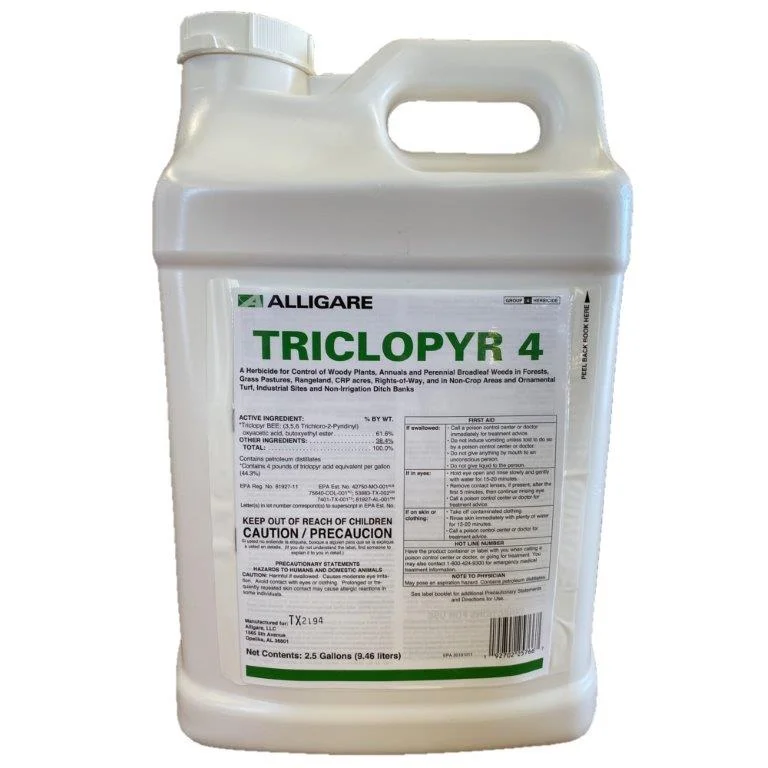
Triclopyr 4 Brush Killer is a post-emergent herbicide used to control thick vegetation in various areas. It is formulated with the active ingredient Triclopyr and is ideal for clearing woody plants, brush, and broadleaf weeds.Triclopyr 4 Brush Killer is manufactured by Alligare and is a systemic selective herbicide used to eliminate trees, brush and woody plants from various types of landscapes. It is ideally used to thin out forests, clear grass pastures, rangelands, and public highways. Triclopyr 4 works systemically, absorbing through the leaves and roots of the plants and interfering with their growth. When trees or broadleaf weeds are obstructing the view of roads, slowing down a construction project, or crowding a residential area, applying Triclopyr 4 Brush Killer can be a useful solution.
- Active Ingredient: Triclopyr BEE- 61.6%
- Triclopyr 4 is highly concentrated
- Alternatively, you can mix Triclopyr with oil instead of water
Labels/SDS
Reviews
I have tried several products to kill Privet hedge with base bark application. This product seems to work at 25% mix with Diesel. The product is at 63%, so mix ratio needs to be calculated with that in mind. Even at that is is a several months long process to clear out an acer of bottomland. Seems that the leaves turn after about three weeks but it is several more weeks, and sometimes a second application, to kill the plant. Seems to depend on size (of course) with the larger trees being the most resistant. There is some residual or runoff effect if you overspray. I would suggest a hand sprayer and spray only when no rain for several days. Although it is mixed with Diesel it is subject to rain weakening the application and preventing full absorption of the product. Good luc.
Frequently Asked Questions
Will this kill grass or only weeds ?
Triclopyr can be used on the following turf type grasses as stated in the manufacturer’s label:
“Apply 1/2 to 1 quart per acre of Alligare Triclopyr 4 in enough water to provide uniform coverage of the target area to control actively growing broadleaf weeds growing in perennial bluegrass, perennial ryegrass, or tall fescue Do not use on other turfgrass species (see Use Precautions section of this label) unless injury can be tolerated To minimize turf injury, do not treat if turf is under heat-or drought-stress and make repeat applications at least 4 weeks apart.”
Please read the label in its entirety for your specific situation.
What is the active ingredient % of glyphosate?
There is no glyphosate in Triclopyr 4EC.
The only Active ingredient is Triclopyr with a concentration 61.6%
Does this have Paraquat in it?
No, the only active ingredient is Triclopyr with a concentration of 61.6%.
In order to kill oriental bittersweet vine (2in diameter), do I apply it undiluted on the stem cut?
Although bittersweet vine is not listed on the label, the following NRCS technical bulletin lists Tryclopyr as an effective herbicide when applying to the cut stump of the vine.
“Systemic herbicides like triclopyr (i.e., Garlon 3A and
Garlon 4) and glyphosate (i.e., Accord, Glypro,
Rodeo) are absorbed into plant tissues and carried to
the roots, killing the entire plant within about a week1.
Garlon 4 is soluble in oil or water, is highly volatile
and can be extremely toxic to fish and aquatic
invertebrates1. It should not be used in or near water
sources or wetlands and should only be applied under
cool, calm conditions. Chemical control is most
effective if the stems are first cut by hand or mowed
and herbicide is applied immediately to cut stem
tissue.”
https://bugwoodcloud.org/mura/mipn/assets/File/Educational%20Resources/Oriental%20Bittersweet%20Mgmt.pdf
Is this a good crabgrass and goose grass remedy in the northern lawn (Ohio)?
Triclopyr 4 EC does not list crabgrass or goose grass control or suppression on the Manufacturer’s label. You may be able to use Acclaim-Extra Selective Grass Herbicide depending on your turf type.
Does this work on poisonous hemlock?
Hemlock is not listed on the manufacturer’s label as a species it controls or suppresses. The University of Maryland Extension has a good bulletin on Poison Hemlock Identification and management.
https://extension.umd.edu/resource/poison-hemlock-identification-and-management/
The following excerpt discusses the chemical control:
“There are several herbicides (e.g. glyphosate, or 2,4-D) on the market to control poison hemlock, so take care which product you select and make sure that you follow the directions on the label for dosage, application, and what personal protection you should wear during application. Most of these herbicides are going to require you to take action on this weed early in the season when this plant is in a seeding or small rosette stage. This may require you to carefully spot spray the rosette at a given height with the appropriate dosage of the herbicide that you are applying for control. If it is too late for your chemical control measures for this year, start planning your control measures for next year/next season today. Keep in mind that the problem is not going to go away with one application of herbicide; this weed is persistent. You may need to combine mechanical and chemical control for best results, and it may take more than one or two years to control this weed.”
How many ounces per gallon of water?
Per the Manufacturer’s label:
“Apply 1/2 to 1 quart per acre of Alligare Triclopyr 4 in enough water to provide uniform coverage of the target area to control actively growing broadleaf weeds growing in perennial bluegrass, perennial ryegrass, or tall fescue Do not use on other turfgrass species (see Use Precautions section of this label) unless injury can be tolerated To minimize turf injury, do not treat if turf is under heat-or drought-stress and make repeat applications at least 4 weeks apart.”
What is the mix ratio per gallon of water for treatment on Bermuda grass lawn for broadleaf weeds? Would this be safe for use on ground cover?
Do not use Tryclopyr 4 on Bermuda lawns. There could be irreversible damage to your Bermuda.
Without knowing what your “ground cover” is specifically, I would not advise using Triclopyr.
Does it kill Japanese stilt grass?
This product does not control Japanese Stiltgrass. We recommend Acclaim Extra since it can specifically Japanese Stiltgrass without killing your Turf grass.
Does this kill off the shoots from heaven tree?
Per the manufacturer’s label, this product does control tree-of-heaven.
What's the percentage of the active ingredient Triclopyr Ester?
The concentration of Triclopyr is 61.6%.
Does this control dandelions?
Per the Manufacturer’s label, yes this product does control dandelions.
Will this kill trees? I have bad wisteria id love to spray but dont want to kill my trees?
Yes, Triclopyr will kill most woody plants. Do not spray Triclopyr on Trees you do not want to potentially harm. You could cut the vines, then immediately treat the stumps with Triclopyr by brushing the herbicide on to the cut stump.
The following is from the manufacturer’s label:
“Cut Stump Treatment
Resprouting of cut stumps of susceptible species can be controlled by mixing 20 to 30 gal-lons of Alligare Triclopyr 4 in enough oil to make 100 gallons of spray solution Apply at low pressure with a backpack or knapsack sprayer; using either solid cone or flat fan nozzles.
Apply to the root collar area, sides of the stump, and the outer portion of the cut surface including cambium The treated area should be thoroughly wet, but do not apply to the point of runoff Vary spray mixture concentration according to size and susceptibility of treated
species Applications can be made at any time of the year, including in winter months Do not apply when snow or water prevent application to the ground line.”
I had a tree cut down and stump ground. Can I put this to the remaining stump to permanently kill it?
Per the Manufacturer’s Label, Yes this product is used for cut stump treatments. Below is an excerpt from the label:
Cut Stump Treatment:
Resprouting of cut stumps of susceptible species can be controlled by mixing 20 to 30 gallons of Alligare Triclopyr 4 in enough oil to make 100 gallons of spray solution Apply at low pressure with a backpack or knapsack sprayer; using either solid cone or flat fan nozzles. Apply to the root collar area, sides of the stump, and the outer portion of the cut surface including cambium The treated area should be thoroughly wet, but do not apply to the point of runoff. Vary spray mixture concentration according to size and susceptibility of treated species Applications can be made at any time of the year, including in winter months. Do not apply when snow or water prevent application to the ground line.
Cut Stump Treatment in Western States:
Resprouting of cut stumps of salt-cedar and other Tamarix spp , bigleaf maple, tanoak, Oregon myrtle, and other susceptible species can be controlled by treating the cambium and adjacent wood around the circumference of the cut stump to wet. Applications may be made at any time during the year, however, reduced control may occur during periods of moisture stress as can occur in late summer Use an applicator which can be calibrated to deliver small amounts.
Please read the label in full to understand how what types of tree (stumps) it does control and how much product to use on the stump.